
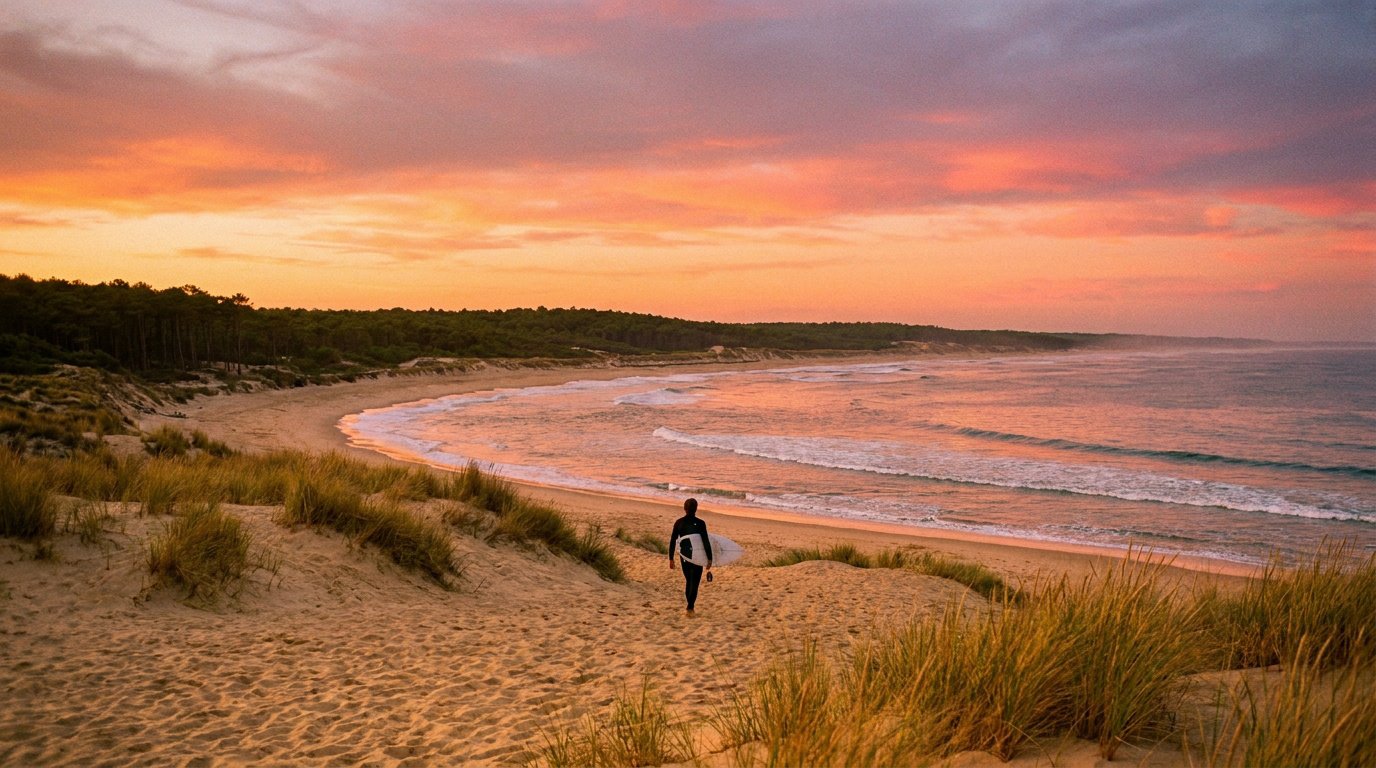
The Landes region encompasses the largest man-made woodland in Western Europe, featuring a 100km coastline of fine sand known as the Silver Coast. Navigating this vast territory often results in logistical friction, where travelers struggle to balance coastal surf culture with the historical depth of the inland thermal hubs and medieval bastides.
This briefing identifies the 15 essential locations and activities to optimize a stay in the Landes, ensuring a comprehensive exploration of its maritime heritage and natural reserves.
- Essential Planning: Things to Do in the Landes Region
- Soorts-Hossegor: Surf Culture and Coastal Lifestyle
- Capbreton: Maritime Heritage and the Estacade
- Biscarrosse: Freshwater Lakes and Atlantic Beaches
- Mimizan: The Silver Coast Natural Gateway
- Dax: Thermal Wellness and Roman Foundations
- Mont-de-Marsan: Urban Exploration in the Three Rivers City
- Courant d’Huchet: Navigating the Little Amazon
- Ecomuseum of Marquèze: Preserving 19th-Century Rural Traditions
- Labastide-d’Armagnac: Medieval Architecture and Local Spirits
- The Vélodyssée: Sustainable Exploration via Coastal Cycle Paths
- Landes Forest: Pine Environment and the 1857 Law
- Moliets-et-Maa: Premier Golfing and Coastal Dunes
- Soustons: Lake Activities and Family-Friendly Leisure
- Messanges: Untamed Beaches and Beginner Surf Spots
Essential Planning: Things to Do in the Landes Region
The Landes region features the 1857-law pine forest, 100km of Atlantic beaches, and thermal hubs like Dax. Summer suits surfers, while autumn favors Armagnac tasting and spa retreats, easily accessible via the Vélodyssée cycle path.
Understanding the logistical framework of the territory ensures a superior travel experience, particularly when aligning personal interests with the specific seasonal rhythms of the Silver Coast.
Seasonal Suitability: Selecting the Optimal Visit Window
Summer months provide peak conditions for ocean surfing and lake swimming. High temperatures facilitate aquatic activities across the coastal resorts. Conversely, the mild autumn atmosphere favors visiting Armagnac vineyards. This period allows for sampling local duck specialties without coastal congestion.
Summer for surfing and swimming; Autumn for Armagnac vineyards, duck specialties, and avoiding crowds; Winter for thermal treatments in Dax.
Winter remains advantageous for specialized thermal treatments in Dax. During these off-peak months, inland bastides offer a silent, preserved charm for visitors.
Regional Mobility: Navigating the Territory Without a Car
The TER train line facilitates primary access by connecting Bordeaux, Dax, and Bayonne. These central hubs function as the principal gateways for entering the region. Reviewing international travel tips for first-time visitors assists in managing these transit connections efficiently.
The « Cars Régionaux de Nouvelle Aquitaine » network, formerly XL’R, provides essential connectivity. These buses link inland stations to coastal destinations like Hossegor, including dedicated summer shuttles.
Bicycles represent the ultimate instrument for local autonomy. The flat topography ensures effortless transit for all demographics.
Soorts-Hossegor: Surf Culture and Coastal Lifestyle
Beyond logistics, the heartbeat of the coast lies in its world-class waves and laid-back atmosphere.
Hossegor functions as the definitive surfing capital of Europe. The municipality hosts elite international competitions at La Gravière, renowned for its powerful beach breaks. Elegant Basque-Landes architecture defines the town’s upscale aesthetic.
The marine lake provides stabilized waters suitable for stand-up paddleboarding activities. Specialized boutique retailers and health-focused cafes characterize the commercial sectors. This environment facilitates a precise integration of athletic rigor and leisure.
Evening assemblies occur predominantly at the Place des Landais. The location offers unobstructed views of Atlantic sunsets. These panoramic vistas represent a primary visual attraction for visitors.
Capbreton: Maritime Heritage and the Estacade
Just across the harbor, the atmosphere shifts from surf chic to traditional maritime grit.
Capbreton functions as the singular fishing port within the Landes department. The Estacade, a structural wooden pier commissioned under Napoleon III, serves to protect the harbor entrance. Patrons acquire fresh catch directly from vessels at the daily fish market.
The Gouf de Capbreton, a significant underwater canyon, lies in immediate proximity to the coastline. This geological formation dictates specific maritime conditions while harboring a high density of diverse marine species. Its presence remains a fundamental factor for local professional fishing.
Traversing the pier facilitates exposure to saline air. Clear atmospheric conditions provide unobstructed views of the Pyrenees.
Biscarrosse: Freshwater Lakes and Atlantic Beaches
Moving north, the landscape transforms into a dual world of salt and fresh water.
Biscarrosse offers two distinct environments for travelers. The ocean side features massive dunes and powerful surf. The inland lakes provide shallow, warm waters for families.
Hydrospeed and sailing are popular on Lake Sanguinet. The Museum of Hydraviation tells the history of early transatlantic flights. It is a unique cultural stop.
Pine forests surround the entire area. Miles of tracks are available for hiking and biking.
Mimizan: The Silver Coast Natural Gateway
Further down the Silver Coast, nature takes center stage at the gateway to the forest.
Mimizan-Plage maintains a reputation for expansive fine sand and a family-oriented environment. The « courant » waterway serves as the physical link between the lake and the ocean. This continuous natural flow generates a visually dynamic and shifting coastal landscape.
The municipality preserves a significant industrial heritage rooted in timber production. Architectural exploration should focus on the Bell Tower, a UNESCO World Heritage site situated on the Saint James Way. This structure functions as a silent medieval witness to regional history.
Floral cultivation defines the aesthetic of the village center. These extensive horticultural displays have secured the highest national ratings for floral quality.
Dax: Thermal Wellness and Roman Foundations
Leaving the coast behind, the interior reveals ancient history and healing waters.
| Site Name | Type | Key Feature | Best For |
|---|---|---|---|
| Fontaine Chaude | Thermal Spring | 64°C natural water flow | Historical sightseeing |
| Borda Museum | History/Art | Local heritage collections | Cultural discovery |
| Thermal Spas | Wellness | Healing mineral waters | Health and relaxation |
| Roman Walls | Archaeology | Gallo-Roman remains | Ancient history buffs |
Dax functions as the primary thermal destination within the French territory. The Fontaine Chaude continuously discharges mineralized water at a constant 64 degrees Celsius. This site has served as a central wellness hub since the Roman era.
The municipality organizes its heritage celebrations during the annual Feria held in August. Participants adopt the traditional red and white attire throughout the festivities. This period integrates regional music with deep-seated local traditions.
Observe the Gallo-Roman fortifications situated in the urban center. These structures represent some of the most intact ancient walls in the country.
Mont-de-Marsan: Urban Exploration in the Three Rivers City
Deeper into the hinterland, the regional capital sits at the confluence of three rivers.
Mont-de-Marsan is recognized as the city of three rivers. The Midou and Douze merge here to form the Midouze. It functions as the administrative center of the Landes.
The Despiau-Wlérick Museum specializes in modern figurative sculpture. This institution occupies a medieval keep. The surrounding gardens facilitate a quiet pedestrian experience.
Local markets provide access to regional culinary products. Procure local duck and Armagnac. These items represent the gastronomic identity of the area.
Courant d’Huchet: Navigating the Little Amazon
Amidst these urban centers, a wild waterway provides a tropical escape.
The Courant d’Huchet is nicknamed the « Little Amazon. » This nature reserve connects Lake Léon to the Atlantic. Professional boatmen guide traditional galupes through the dense, lush vegetation.
Booking a boat trip (galupe) in advance is essential due to high demand and the protected status of the nature reserve. For July and August, a three-week lead time is recommended.
Rare birds and exotic plants thrive in this protected ecosystem. It is a paradise for photographers. The silence is only broken by water.
Booking a boat trip in advance is essential. It is the best way to see it.
Ecomuseum of Marquèze: Preserving 19th-Century Rural Traditions
To truly understand the Landes, one must travel back in time to a vanished way of life.
Access the Ecomuseum of Marquèze via a vintage train. The site recreates a 19th-century airial, a traditional hamlet. It shows how shepherds lived before the forest.
Staff demonstrate old crafts like bread baking and spinning. You can see the famous Landes stilts in use. It is very educational for children.
The local mill still grinds corn today. Taste the authentic « pastis landais » cake on site.
Labastide-d’Armagnac: Medieval Architecture and Local Spirits
In the eastern reaches, fortified villages offer a taste of history and liquid gold.
Labastide-d’Armagnac is one of the most beautiful bastides in France. The Place Royale inspired the Place des Vosges in Paris. Its stone arches remain perfectly intact.
This area is the home of Armagnac brandy. Many local producers offer tours and tastings. The aging process in oak barrels is fascinating.
Visit the nearby chapel dedicated to cyclists. It houses jerseys from famous Tour de France winners.
- Place Royale architecture
- Armagnac tasting cellars
- The Notre-Dame-des-Cyclistes chapel
The Vélodyssée: Sustainable Exploration via Coastal Cycle Paths
Exploring these diverse sites is best done at a slower, more sustainable pace.
The Vélodyssée represents a premier cycle route tracing the Atlantic coastline. This infrastructure features predominantly flat terrain and maintains strict separation from motorized traffic. Consult an international travel packing list checklist to prepare for this specific outdoor excursion.
The designated path traverses extensive pine forests and coastal dune systems. It serves as a strategic link between all primary seaside resorts. Specialized bicycle rental services are operational within every transit town.
This network facilitates carbon-neutral regional travel. The atmospheric combination of maritime air and forest scents provides an invigorating sensory experience.
Landes Forest: Pine Environment and the 1857 Law
The cycle paths exist because of a massive environmental transformation in the 19th century.
The Landes forest is the largest man-made woodland in Western Europe. Napoleon III passed the Law of 1857 to drain the marshlands. Millions of maritime pines were planted to stabilize the soil and provide timber.
Year of the law to drain marshes.
Hectares covered by the forest.
Length of the Silver Coast beaches.
This changed the local economy forever. Resin tapping was once the main industry. Now, forestry and tourism dominate the region.
The forest provides a unique, quiet atmosphere. It covers nearly one million hectares.
Moliets-et-Maa: Premier Golfing and Coastal Dunes
Within this vast forest, pockets of luxury and sport emerge near the shore.
Moliets-et-Maa is famous for its world-class golf course. Some holes are located right on the dunes. It offers a challenging game with ocean views.
The Courant d’Huchet meets the sea here. The beach is wide and wild. It is a popular spot for sunset walks.
The village itself has a charming, traditional feel. Local restaurants serve excellent seafood and duck.
Soustons: Lake Activities and Family-Friendly Leisure
For those seeking calmer waters, a nearby town offers a different aquatic experience.
Soustons is centered around a large freshwater lake. It is much safer for small children than the ocean. You can rent kayaks or stand-up paddles.
- Kayaking on the lake
- The annual Tulip Festival
- Traditional Course Landaise events
The town is famous for its rose and tulip gardens. It hosts a vibrant festival every spring. The Course Landaise is also held in the local arena.
The surrounding woods have many shaded picnic spots. It is a very relaxing place for families.
Messanges: Untamed Beaches and Beginner Surf Spots
Finally, for a raw connection with the Atlantic, one last stop offers pure coastal beauty.
Messanges offers a more rugged and natural beach experience. The dunes here are massive and untouched. It is less crowded than the neighboring resorts.
The surf schools here are great for beginners. The waves are often more manageable. Consult this international carry-on packing list before your trip.
Camping is the most popular way to stay here. It allows for a deep connection with nature.
Mastering the Landes region requires balancing coastal surf culture, the 1857-law pine forests, and Dax’s Roman thermal heritage. Secure boat reservations for the Courant d’Huchet immediately to ensure access to this unique ecosystem. Experience the ultimate Atlantic retreat where sustainable cycling meets world-class gastronomy.
FAQ
What are the primary coastal destinations for a stay in the Landes?
The Silver Coast features 100 kilometers of fine sand beaches, accommodating several major seaside resorts. Key locations include Soorts-Hossegor, recognized as the surfing capital, Capbreton with its unique fishing port, and family-oriented centers such as Biscarrosse-Plage, Mimizan, and Moliets-et-Maa.
Which inland cities offer significant historical and cultural heritage?
Dax stands as a premier destination, serving as France’s leading thermal hub with foundations dating back to the Roman era. Mont-de-Marsan, known as the « City of Three Rivers, » provides a rich medieval center and is designated as the « Capital of Sculpture » due to the specialized collections at the Despiau-Wlérick Museum.
How can visitors explore the regional nature reserves and waterways?
The Courant d’Huchet, often referred to as the « Little Amazon, » offers immersive boat tours in traditional galupes to observe its exceptional biodiversity. Additionally, the Leyre river provides opportunities for kayaking through the pine forest, while numerous lakes like Soustons and Hossegor are optimized for paddleboarding and sailing.
What sustainable transportation options are available for touring the coast?
The Vélodyssée represents the primary infrastructure for sustainable mobility, consisting of a vast network of flat, well-maintained cycle paths. This route allows for seamless travel between seaside resorts, winding through the maritime pine forest and dunes while remaining entirely separated from motorized traffic.
What characterizes the local gastronomy and traditional events?
Regional culinary offerings focus on terroir products, including duck, Armagnac, asparagus, and fresh seafood from the Capbreton market. Cultural engagement is centered around local markets and Ferias, which feature traditional music, bandas, and Course Landaise events in local arenas.
What unique historical sites showcase the 19th-century rural lifestyle?
The Ecomuseum of Marquèze preserves the traditional Landes identity by recreating a 19th-century airial. Accessible via a vintage train, the site demonstrates ancestral crafts, the use of stilts by shepherds, and the architectural heritage of the region prior to the massive forestation mandated by the Law of 1857.